
This project explores how an eCommerce business can improve conversion rates and overall revenue. By analysing user behaviour across the purchase funnel, channel and device performance, customer value, and product level factors, the aim is to identify key drop-off points and uncover actionable opportunities for growth.
To identify the key drivers of conversion and revenue, the analysis is structured around the following questions:
- Where are users dropping off in the funnel?
- Which channels and devices perform best (and worst)?
- What factors influence conversion and purchase behaviour?
- Which customers are most valuable?
- Do product ratings and reviews impact sales?
Note: As this is a synthetic dataset, insights should be interpreted as directional rather than definitive.
1. Where are users dropping off in the funnel?
Analysing user progression from session to purchase to identify key drop-off points in the conversion funnel.
The purchase funnel was defined as: Session → Add to Cart → Conversion. This analysis examines how users progress through each stage to identify where the largest drop-offs occur.

Although nearly half of users (46.5%) add items to their cart, less than a quarter of them (23.2%) complete a purchase, leading to an overall conversion rate of just 10.8%.
This sharp decline suggests substantial friction at the final stage of the purchase journey, particularly between product discovery and checkout. Improving the user experience at key stages such as product pages or the checkout flow could increase overall conversion rates.
Potential optimisation opportunities include simplifying the checkout flow, improving pricing transparency earlier in the journey, and testing stronger trust signals such as reviews or guarantees at the point of purchase.
2. Which channels and devices perform best (and worst)?
Evaluating performance across acquisition channels and devices to identify high-impact growth opportunities.
Performance was analysed across channel and device combinations, using both traffic volume and conversion rate (CVR) to identify high performing segments and areas for optimisation.
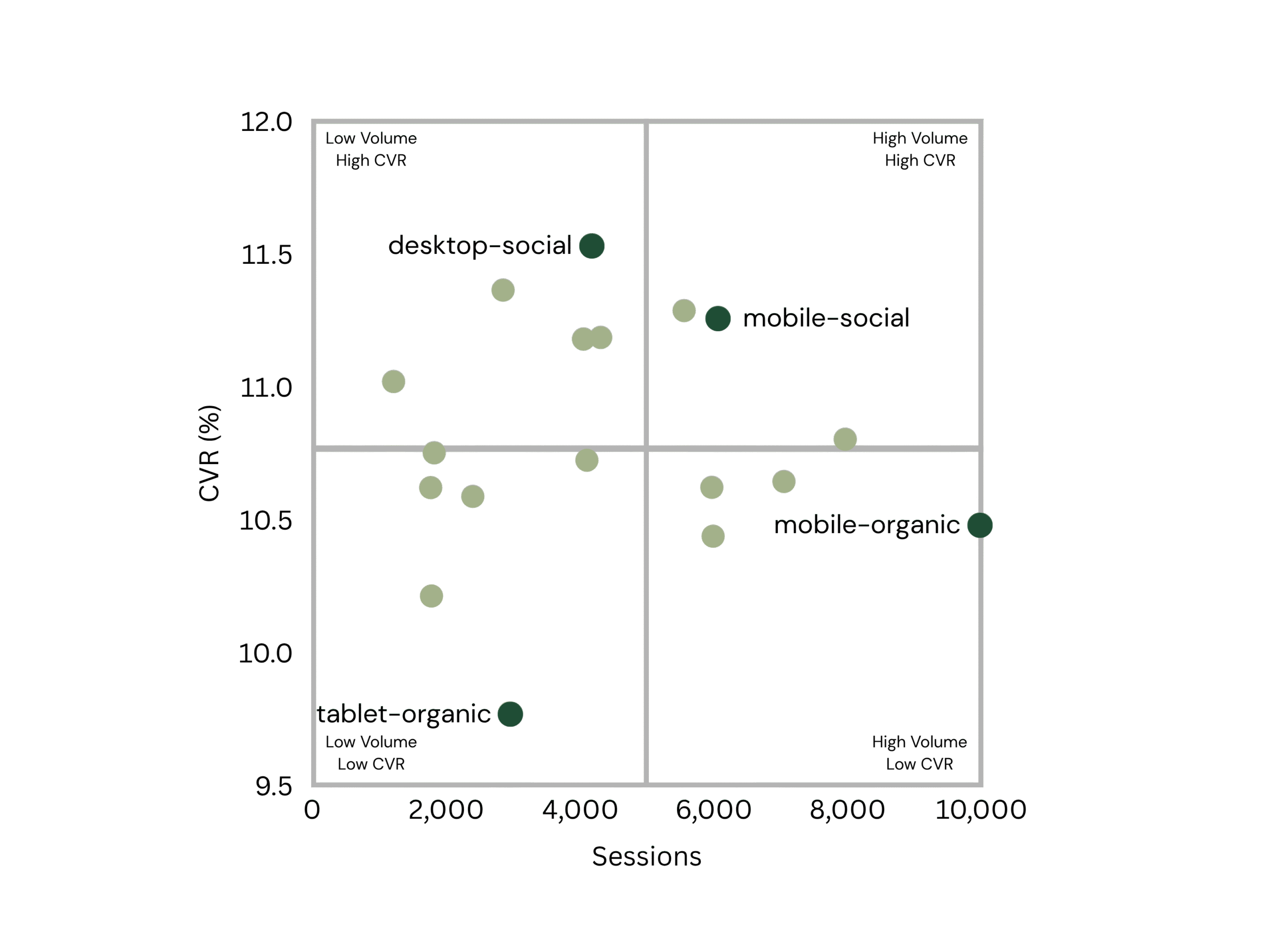
Clear differences emerge when comparing channel and device performance across both volume and conversion rate. Mobile traffic from social channels performs strongly, combining high volume with high conversion rates, making it a key driver of revenue.
In contrast, mobile traffic from organic channels generates the highest volume but has relatively low conversion rates, representing the largest opportunity for improvement. Desktop social traffic shows the opposite pattern, with high conversion rates but relatively low volume, indicating potential for scaling. Tablet traffic, particularly from organic channels, performs poorly across both metrics and contributes minimally to overall conversions.
To maximise impact, efforts should focus on improving mobile organic performance through faster load times, clearer CTAs, and a simplified checkout experience. High performing segments should be maintained, while high conversion, low volume channels offer opportunities for scaling. Low impact tablet traffic can be deprioritised.
3. What factors influence conversion and purchase behaviour?
Analysing user interactions and engagement patterns to understand what drives conversions.
User behaviour was analysed across key engagement metrics, including cart activity, page views, session duration and bounce rate to understand how interaction patterns differ between converting and non-converting users.
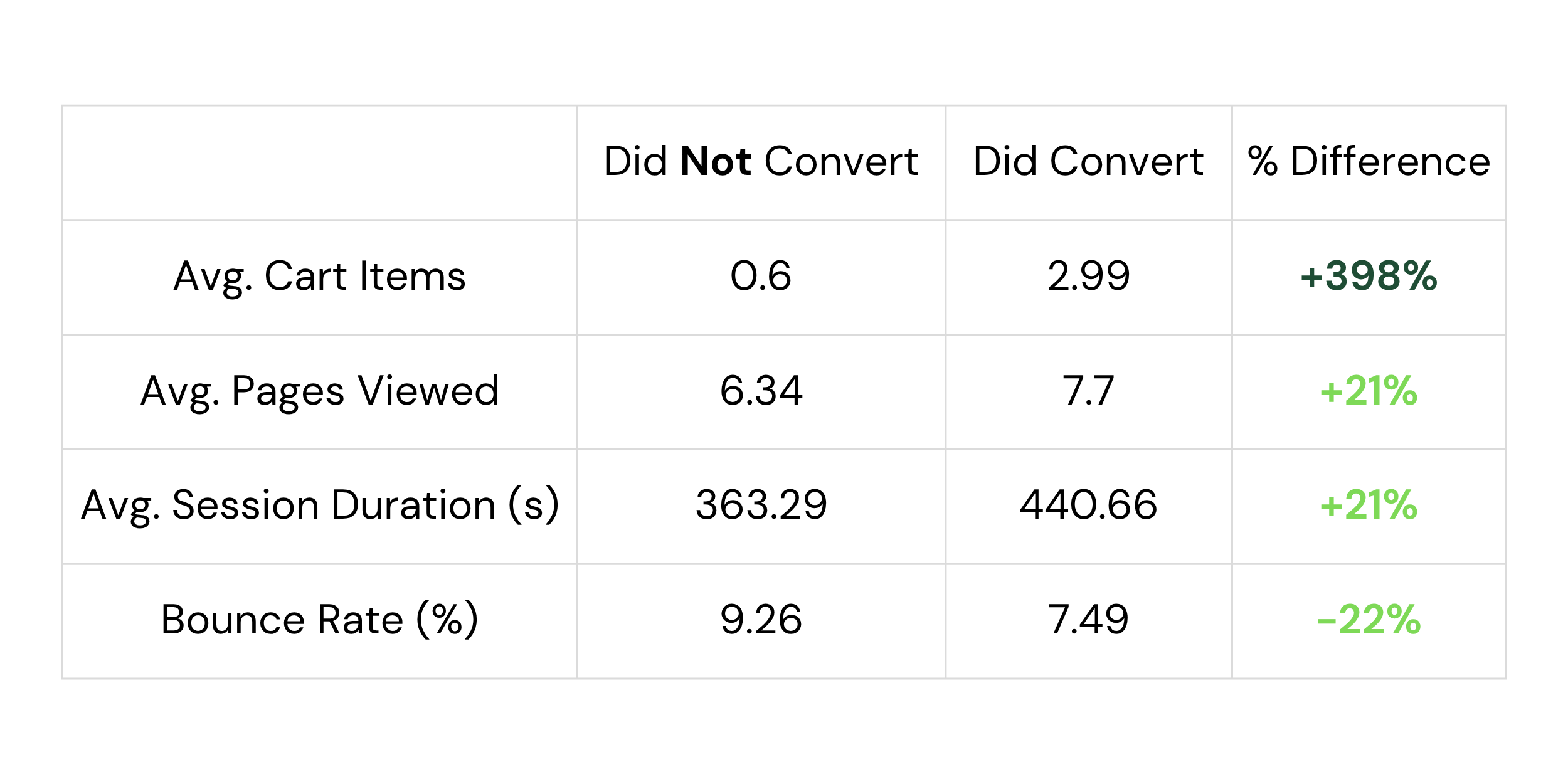
Clear behavioural differences emerge between converting and non-converting users across key engagement metrics. Converting users spend more time on site (440 vs 363 seconds), view more pages (7.7 vs 6.3), and are less likely to bounce, indicating stronger engagement throughout their journey.
The most pronounced difference is in cart activity, where converting users add nearly 5x more items to their cart (2.99 vs 0.6), highlighting cart interaction as the strongest indicator of purchase intent. This substantial gap suggests that progression to the cart stage is a critical step in driving conversion.
While statistical testing was not conducted, the magnitude of these differences indicates clear behavioural patterns.
To improve conversion, efforts should focus on increasing engagement and encouraging progression to the cart stage. This includes enhancing product pages with clearer content and stronger CTAs, improving navigation and product discovery, and reducing early stage friction. Incentives such as free shipping thresholds or limited time offers can further encourage cart additions and increase purchase likelihood.
4. Which customers are most valuable?
Segmenting users by value to identify high-impact customer groups.
Customer lifetime value (CLTV) was used to evaluate how revenue is distributed across different user segments and to assess the impact of engagement factors such as app usage and email opt-in on longterm customer value.
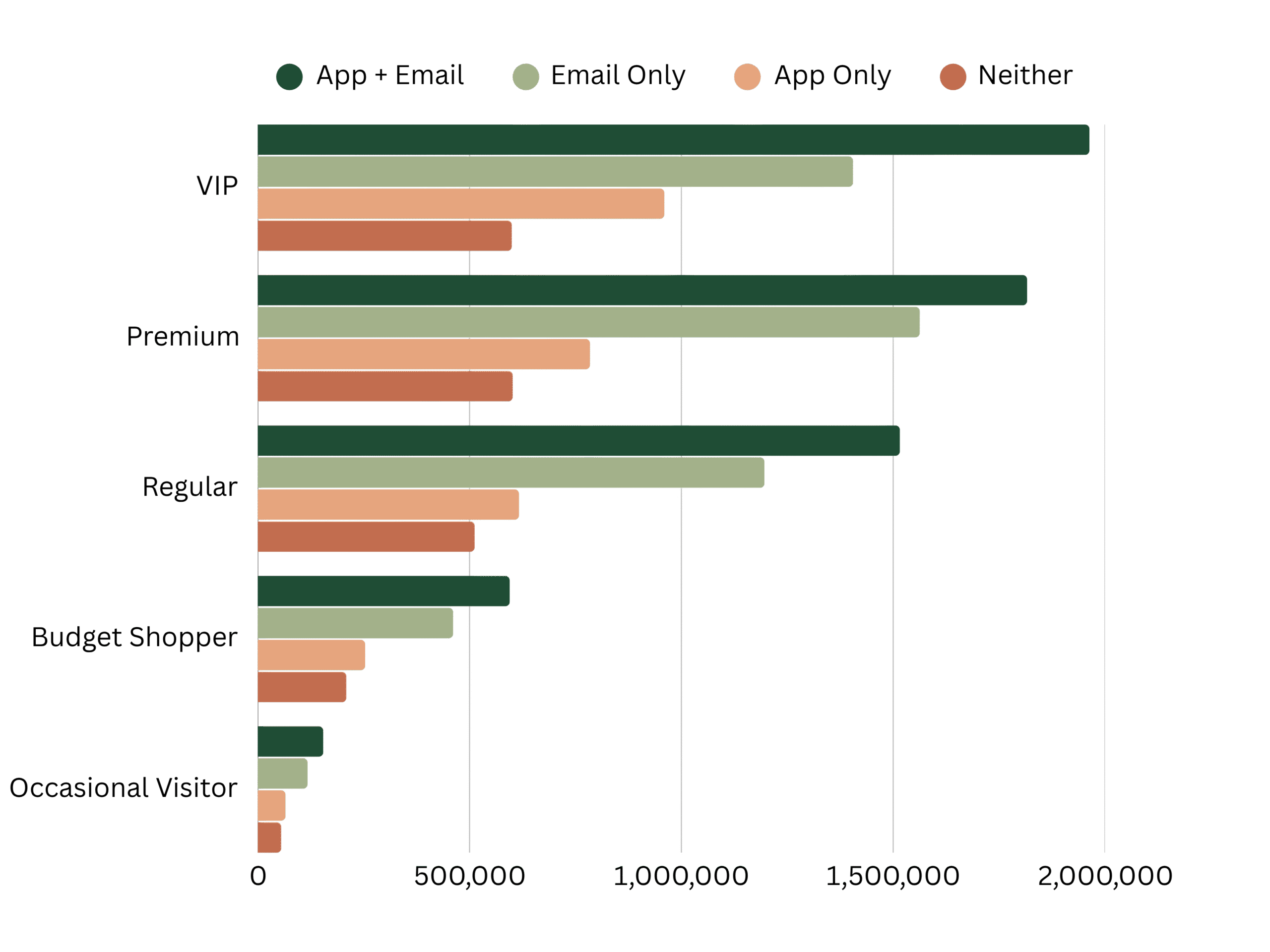
Multi-channel engagement emerges as the strongest driver of customer value, with customers using both app and email consistently generating the highest lifetime value across all segments.
When comparing single channel users, a clear pattern emerges: email-only customers outperform app-only users across the board. In total, email-only users generate approximately 1.8x more lifetime value than app-only users, indicating that email is a more effective driver of monetisation than app usage alone.
This suggests that customer value is driven less by segment alone and more by the level and type of engagement across channels.
To maximise customer value, efforts should focus on strengthening email capture and engagement, while encouraging email users to adopt the app to unlock additional value. Expanding multichannel usage across lower value segments represents a scalable opportunity for growth, while continuing to retain and nurture highly engaged customers remains critical.
5. Do product ratings and reviews impact sales?
Exploring the relationship between product ratings, review volume, and revenue performance.
Product performance was analysed across rating categories to assess how customer ratings and review volume influence both average revenue per product and overall sales.


Note: Bubble size represents the volume of product ratings.
Product ratings show a clear relationship with revenue, particularly in terms of value per product. Higher rated products consistently generate greater average revenue, with “Excellent” rated products earning approximately 27% more per product. This suggests that customer perception of quality increases willingness to pay.
However, “Good” rated products generate the highest total revenue, driven by significantly higher sales volume. This indicates that while top rated products command higher value, slightly lower rated products may scale more effectively and contribute more to overall revenue.
To maximise revenue, the business should focus on improving ratings of high volume “Good” products, as small improvements could significantly increase both conversion and value. High rated products should be prominently featured to drive higher value purchases, while underperforming products should be reviewed and improved or deprioritised. Encouraging more customer reviews can also increase trust and support both conversion and pricing power.
Conclusion
To improve conversion and revenue, the business should focus on a small number of high-impact opportunities identified across the analysis.
Prioritise for growth: Simplify the checkout flow by reducing steps and improving price transparency (e.g. showing shipping costs earlier), optimise mobile organic performance by improving page load speed, simplifying layouts, and making CTAs more prominent, increase progression to cart through stronger product pages (clearer images, better descriptions) and incentives such as free shipping thresholds, strengthen email capture through sign-up prompts and drive engagement with personalised campaigns, encourage app adoption among existing email users through targeted incentives, and improve ratings of high-volume “Good” products by addressing common issues and encouraging more customer reviews.
Deprioritise: Investment in underperforming tablet channels and low-engagement user segments, where both traffic and conversion rates are low and unlikely to deliver meaningful returns.